PENGENALAN
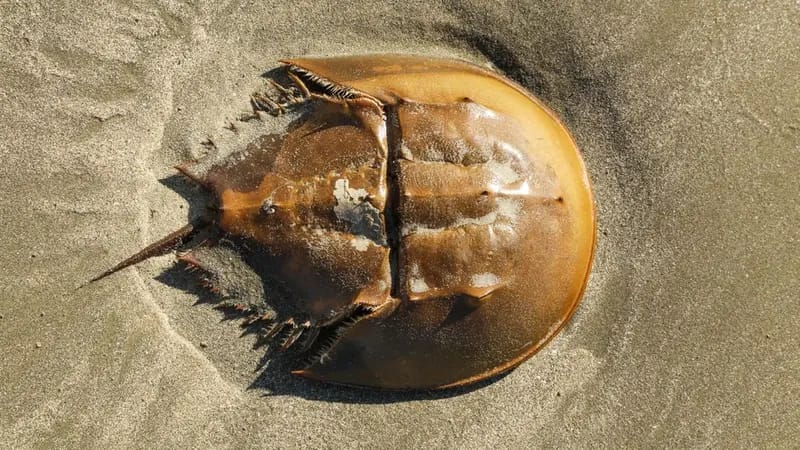
Horseshoe crabs are one of the estuarine chelicerata species (chelipeds), known as "living fossils" because they have been around for more than 450 million years. There are four extant horseshoe crab species in the world, namely Limulus polyphemus, Tachypleus tridentatus, Tachypleus gigas, and Carcinoscorpius rotundicauda. Horseshoe crabs have a special ability to see in murky waters, distinguish colours and shapes of horseshoe crab larvae have a positive response to light. Horseshoe crabs have a ladam or horseshoe shape and have hard skin and have potential for health. In addition to its unique shape this crab also has blue blood, this crab, also referred to as the Horseshoe Crab, is a living fossil that dates back 450 million years and survived the ice age. HORSESHOE CRABS AS HUMAN SAVIOURS The crab, which has blue blood thanks to its copper-based SE respiratory pigment or haemocyanin, has a huge contribution to the manufacture of vaccines and medicines that can save humans. The blue blood contained in horseshoe crabs contains immune cells and is highly sensitive to toxic bacteria. When these cells encounter invading bacteria, they clot around it and protect the entire body of the horseshoe crab from the toxins. The blood of horseshoe crabs or mullets is said to have an important role in the manufacture of the Covid-19 vaccine because it is able to detect bacterial contamination contained in the vaccine. The blood of these crabs is able to detect endotoxin, a substance released by bacteria when the bacteria die. Since endotoxins can kill humans if they enter the bloodstream, harvesting the blood of these ancient crabs for medical research remains common.
DECLINING POPULATION OF THIS SPECIES
Horseshoe crabs play a role in the food chain cycle (Hu et al., 2022). In addition, it also plays a role in the biomedical industry (Krisfalusi-Gannon et al., 2018), and its eggs are widely consumed by the public (Azizah et al., 2019). This has led to a high level of utilisation of horseshoe crabs, which has resulted in the threat of extinction, such as that of the endangered Tachypleus tridentatus and vulnerable Limulus polyphemus (IUCN, 2018). (IUCN, 2018). The extinction of these biota is also caused by their degraded habitat (Meilana et al., 2016). Horseshoe crab habitats are in mangrove ecosystems, estuaries, and lagoons with muddy sand substrates. Horseshoe crab populations worldwide are showing a declining trend as a result of overexploitation.
ALTERNATIVES TO REPLACE BLUE BLOOD FROM HORSESHOE CRABS
An alternative found for now to replace the blue blood that horseshoe crabs have is KLH (Green sea crab), KLH (Green Sea Crab) has the potential to replace horseshoe crab blue blood in several medical applications, mainly due to its coagulation properties and immunological response. The reason KLH can be used as an alternative is because KLH itself is able to produce an immune system like horseshoe crabs, but further research is still being carried out to find out whether KLH can indeed be an alternative.
REFERENSI
Anggraini, R., & Karlina, I. (2023). Pengetahuan Masyarakat Lokal Terkait Keberadaan Kepiting Tapal Kuda dan Distribusinya di Sepanjang Pesisir Pulau Bintan. Jurnal Kelautan Tropis, 26(1), 19–26. https://doi.org/10.14710/jkt.v26i1.15693
Azizah, N., Wahyudi, E.R., Nissa, K., Wahyudi, A.F. & Ummah, S.K. (2019). Pemberdayaan Istri Nelayan Melalui Pelatihan Digital Marketing Strategy (Dms) Darah Biru. Dinamisia :Jurnal Pengabdian Kepada Masyarakat, 3(1), 131-141. doi: 10.31849/dinamisia.v3i1.2675
Hu, M., Kwan, K.Y., Xie, Z., Cheung, S.G., Wang, Y., & Shin, P.K. (2022). Trophic relationship of sympatric juvenile Asian horseshoe crabs in Beibu Gulf, Southwestern China. In International Horseshoe Crab Conservation and Research Efforts: 2007-2020: Conservation of Horseshoe Crabs Species Globally (pp. 633-649). Cham: Springer International Publishing. doi: 10.1007/978-3-030-82315-3_37
Krisfalusi-Gannon, J., Ali, W., Dellinger, K., Robertson, L., Brady, T.E., Goddard, M.K., Tinker-Kulberg, R., Kepley, C.L. & Dellinger, A.L. (2018) The Role of Horseshoe Crabs in the BiomedicalIndustry and Recent Trends Impacting Species Sustainability. Frontiers in Marine Science, 5, p.185. doi: 10.3389/fmars.2018.00185
Meilana, L., Wardiatno, Y., Butet, N.A., & Majariana, K. (2016). Karakter Morfologi Dan Identifikasi Molekuler Dengan Marka Gen Co1 Pada Mimi (Tachypleus cigas) Di Perairan Utara Pulau Jawa. Jurnal Ilmu Dan Teknologi Kelautan Tropis, 8(1), 145–158.
Sundah, R. Z. K., Setiyono, H., Aini, N. K., & Miranda, H. (2024). Sebaran Habitat Asuh Spesies Kepiting Tapal Kuda Di Pantai Pendopo Teritip, Balikpapan. Indonesian Journal of Oceanography, 6(3), 218–228. https://doi.org/10.14710/ijoce.v6i3.16539